

Here they are …. hope you enjoy them …
2019-08-25 – Online generation gap in Quebec narrowing, study suggests
Online generation gap in Quebec narrowing, study suggests
Streaming, social media, and shopping still more popular among younger people
- Montreal Gazette, Canada
- Aug 23, 2019
- Page: A2
JOHN MAHONEY A new survey finds 96 per cent of people in Quebec age 18 to 24 are on the internet at least once a day while 61 per cent of those over age 65 in the province went online daily.
Quebec’s generation gap when it comes to internet use is narrowing as an older audience embraces the web, according to a survey by the Centre facilitant la recherche et l’innovation dans les organizations (CEFRIO), an organization that works to promote digital technology in the province.
Internet use in Quebec still varies from one generation to another, but an examination of that use in 2018 by CEFRIO found the demographic split between those who regularly access online technology and those who do not is now manifested around the age of 55, 10 years older than was the case several years ago.
CEFRIO’s study, titled NETendances 2018 and made public on Thursday, found that 96 per cent of users age 18-24 were on the internet at least once a day, a proportion that dropped to only 95 per cent for those age 25 to 34.
Meanwhile, 61 per cent of users age 65 and over were on the internet at least once a day.
A total of 97 per cent of users age 18 to 24 said they own a smartphone, although that same demographic group had the lowest proportion of electronic tablet owners.
Tablets were found to be most popular with users age 35-54, with 63 per cent of that age group saying they own one.
Smart watches were owned by only 10 per cent of users in any demographic.
CEFRIO noted that 77 per cent of adults age 18 to 24 subscribed in 2018 to an online streaming service providing them with movies and shows. That proportion dropped to 65 per cent for those age 25-34, 50 per cent for the 35-54 demographic, 44 per cent for users age 55-64 and 31 per for those age 65 and over.
The use of social media by all age groups younger than 65 varied from 78 per cent to 98 per cent, and the proportion was 49 per cent for those age 65 and older.
YouTube was the preferred social media platform for those age 18-34 while Facebook was the network most used by those 35 and older. Instagram and Snapchat were most popular with users age 18 to 24.
Online shopping at least once a year was far more popular with users age 18 to 54 (varying from 73 to 81 per cent depending on the demographic group) than with those age 55-64 (47 per cent) and 65 and older (30 per cent).
Clothing, shoes, jewels and accessories were the most common online purchases made by all age groups.
While 55 per cent of all respondents said they have a positive view of smart technology and hardware, that enthusiasm waned for those age 55-64 (43 per cent) and over 65 (40 per cent).
Meanwhile, 83
per cent of those age 18-24 had a positive view of the role of digital technology
in their daily lives.
2019-08-24 – Man behind Alzheimer’s fund hopes to inspire
Man behind Alzheimer’s fund hopes to inspire
- Montreal Gazette, Canada
- Aug 21, 2019
- Page: A3
DAVE SIDAWAY Andrew Harper, 96, created a $500,000 endowment fund to help finance the operating costs of a new activity centre at the Alzheimer Society of Montreal. The organization will honour Harper on Aug. 27.
My father inspired me to be a giver. He used to say, ‘If you help somebody in need, you will see that God will take care of you.’
Andrew Harper’s father, Simon, lived to be nearly 99 years old. For most of that time, he had what Andrew described as a “brilliant mind.” But he developed dementia and became unmoored, slowly but inexorably, from daily life in a decline that has been called the long goodbye.
“It was not easy,” recalled Andrew, a retired Montreal businessman who will soon celebrate his 97th birthday.
With his father in mind, he has created a $500,000 endowment fund at the Alzheimer Society of Montreal in his name and that of his beloved wife, who died in 2015. The Andrew and Carole Harper Alzheimer Society of Montreal Endowment Fund will be launched next Tuesday at the organization’s St-Henri headquarters and a plaque unveiled to honour and thank the couple.
Another goal of the Aug. 27 event is to raise awareness of the work of the Alzheimer Society of Montreal and to encourage other donors to step forward, said executive director Camille Isaacs-Morell.
The number of people living with dementia is increasing steadily and it is estimated that by 2031 more than 50,000 Montrealers will be living with Alzheimer’s disease or a related disorder — an increase of 66 per cent from 2016, she said. Already there has been a sharp increase in the demand for education services and training for caregivers and others who work in CLSCs and residences looking after people with dementia, she said, and the organization hopes to nearly double the number of clients it serves to 3,500 within five years.
With the largest network of community-based services on the island, the Alzheimer Society of Montreal has partnerships with more than 50 community organizations and in 19 service points offers respite, stimulating activities, counselling services, information and support groups, conferences and more.
This year’s operating budget is $2.3 million, of which $750,000 comes from the government, $850,000 from major donations and direct-mail campaigns, $540,000 from major fundraising events and third-party activities and about $100,000 from other programs. Although individual donations are appreciated, the organization is “looking to establish partnerships and have recurring donations” to reduce its heavy dependence on government subsidies, said Isaacs-Morell.
The Harper endowment fund will help support the operating budget of a planned activity centre in the organization’s Notre-Dame St. W. building that will accommodate 20 to 40 people daily, four or five days a week.
Said Andrew Harper of the gift: “I like to think that my wife will somehow know it and approve.” The Harpers were longtime contributors to the Alzheimer Society of Montreal and Carole helped to plan the organization’s annual fundraising ball.
In keeping with his wife’s “generous ways,” he decided he wanted do more to help the broader community. “I feel that whatever I am doing should be an example to others to follow in my footsteps,” he said in a recent interview in his apartment.
He was also philosophical: “I can’t take it with me.”
His $500,000 gift to the Alzheimer Society of Montreal is being made through the Andrew and Carole Harper Tolerance Fund set up at the Jewish Community Foundation. It follows a $1 million donation in 2018 to Chez Doris, a day centre in downtown Montreal that helps disadvantaged women, and an earlier $1.2 million donation to the MADA Community Centre for improvements to its Décarie Blvd. building that included an elevator, a ramp for strollers and wheelchairs, new entrance doors and an expanded lobby.
Harper, who is Jewish, left his native Bucharest with his brother in 1940 after the Nazis occupied Romania and they ended up in Havana, where their parents joined them. He studied at university there and then in Miami, where he was drafted into the United States Army Air Force and worked in the counter-intelligence corps.
After leaving the army, Harper earned a degree in business administration from Columbia University, returned to Havana for graduate work and then worked for the DuPont company, headquartered in Wilmington, Del. A friend introduced him to Carole Hymes, a New York City native, and the two married in 1954. They moved to Montreal, where Carole helped him open a business importing fine foods, chocolates and biscuits. They retired about 30 years ago and lived happily together until Carole’s death.
These days, Harper enjoys chess, works out twice weekly with a trainer and regularly dines out with friends. And he remembers his father’s example.
“Some people are takers and others are givers,” he said. “My father inspired me to be a giver. He used to say, ‘If you help somebody in need, you will see that God will take care of you.’ ”
Learn more at www.alzheimermontreal.ca.
2019-08-24 – Wisdom ..

2019-08-23 – Never too old …
CBC Docs POV – Never Too Old : Olive Bryanton, 81, is working hard to get a PhD and help change the world for older women in Canada: “a little old lady, I am not!”
From: CBC POV Docs ..
2019-08-21 – Old age” is made up—and this concept is hurting everyone
https://www.technologyreview.com/s/614155/old-age-is-made-upand-this-concept-is-hurting-everyone/
Old age” is made up—and this concept is hurting everyone.
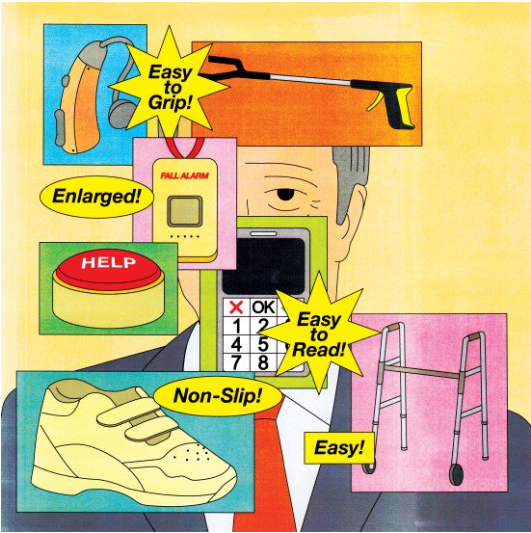
Products designed for older people reinforce a bogus image of them as passive and feeble.
by Joseph F. Coughlin, Aug 21, 2019
Illustration of senior with products targeted to seniors – GEORGE WYLESOL
Of all the wrenching changes humanity knows it will face in the next few decades—climate change, the rise of AI, the gene-editing revolution—none is nearly as predictable in its effects as global aging. Life expectancy in industrialized economies has gained more than 30 years since 1900, and for the first time in human history there are now more people over 65 than under 5—all thanks to a combination of increasing longevity, diminished fertility, and an aging Baby Boom cohort. We’ve watched these trends develop for generations; demographers can chart them decades in advance.
And yet we’re utterly unprepared for the consequences.
We are unprepared economically, socially, institutionally, and technologically. A wide swath of employers in the US—in both industry and government—are experiencing what has been called a retirement brain drain, as experienced workers depart crucial roles. At the same time, unemployed older workers struggle to find good jobs despite unemployment rates now at a 50-year nadir. Half of older longtime job holders, meanwhile, are pushed out of their jobs before they planned to retire. Half of Americans are financially unprepared for retirement—25% say they plan to never stop working—and state pension systems are hardly better off. Public transportation systems, to the limited extent they even exist outside of major cities, are unequal to the task of ferrying a large, older, non-driving population to where it needs to go. The US also faces a shortage of professional elder-care providers that only stands to worsen as demand increases, and in the meantime, “informal” elder care already extracts an annual economic toll of $522 billion per year in opportunity cost—mainly from women reducing their work hours, or leaving jobs altogether, to take care of aging parents.
And yet these problems might turn out to be surprisingly tractable. It’s strange, for instance, that employers are facing a retirement crisis at the same time that many older workers have to fight outright ageism to prove their value—sort of like a forest fire coexisting with a torrential downpour. For that matter, it’s strange that we, as a society, put obstacles in the way of older job seekers given that hiring them could help prevent programs like Social Security and Medicare from running out of money.
The MIT AgeLab, which I head, has homed in on one such paradox in particular: the profound mismatch between products built for older people and the products they actually want. To give just a few examples, only 20% of people who could benefit from hearing aids seek them out. Just 2% of those over 65 seek out personal emergency response technologies—the sorts of wearable devices that can call 911 with the push of a button—and many (perhaps even most) of those who do have them refuse to press the call button even after suffering a serious fall. History gives us many examples of such failed products, from age-friendly cars to blended foods to oversize cell phones.
In every example, product designers thought they understood the demands of the older market, but underestimated how older consumers would flee any product giving off a whiff of “oldness.” After all, there can be no doubt that personal emergency response pendants are for “old people,” and as Pew has reported, only 35% of people 75 or older consider themselves “old.”
Asking young designers to merely step into the shoes of older consumers (and we at the MIT AgeLab have literally developed a physiological aging simulation suit for that purpose) is a good start, but it may not be enough to give them true insight into the desires of older consumers.
There’s an expectations gap between what older consumers want from a product and what most of these products deliver, and it’s no frivolous matter. If you need a hearing aid but no one can make one that you think is worth buying, that will have serious ramifications for your quality of life, and may lead to social isolation and physical danger down the road.
But the expectations gap is also—here’s that word again—strange. Why do products built for older people so often seem so uninspiring—big, beige, and boring? It’s not that older people don’t have money. The 50-plus population controls 83% of household wealth in the US and spent more in 2015 than those younger than 50: nearly $8 trillion of economic activity, if you include downstream effects. Granted, that wealth is unequally distributed, but if better products existed, you’d expect to see them snapped up by the people with more money, and that hasn’t happened (with a handful of very recent exceptions I’ll discuss).
And don’t try to tell me the real issue is that older people aren’t tech savvy. Maybe that stereotype once contained a grain of truth—in 2000, just 14% of 65-plus America used the internet—but it’s no longer the case. Today, 73% of the 65-plus population is online, and half own smartphones.
The expectations gap, then, is the sort of vacuum one would expect nature not to tolerate. If you believe that markets, given enough demand, tend to solve problems sooner or later, the gap’s persistence is uncanny: like a Volkswagen-size boulder hovering six inches off the ground.
Don’t worry; there is a natural explanation—and it holds clues for how we can turn many paradoxical problems of global aging into opportunities.
The “golden years” hoax
The root cause of all this daylight—between products and consumer expectations, between employer and older worker, between what 75-year-olds think of as “old” and their self-conception—is disarmingly simple. “Old age,” as we know it, is made up.
To be sure, a full Whitman’s Sampler of unpleasant biological contingencies can arrive with age, and death ultimately comes for us all. But the difference between those hard truths and the dominant narrative of old age that we’ve inherited is big enough and persistent enough to account for the expectations gap—and then some.
Two hundred years ago, no one thought of “the aged” or “the old” as a population-size problem to be solved. But that changed thanks to a confluence of since-debunked science and frenzied institution-building. In the first half of the 19th century, doctors, especially in the US and UK, believed that biological old age occurred when the body ran out of a substance known as “vital energy,” which, like energy in a battery, was consumed over the course of a lifetime of physical activity, never to be replenished. When patients began to display key signs of old age (white hair, menopause), the only medically sound response was to insist they cut back on all activities. “If death resulted from an exhausted supply of energy, then the goal was to retain it at all cost,” historian Carole Haber wrote in her 1994 book Old Age and the Search for Security, “by eating the correct foods, wearing the proper clothes, and performing (or refraining from) certain activities.” Sex and manual labor were both considered to be especially draining.
By the 1860s, modern notions of pathology had begun to replace vital energy in continental Europe, and they eventually found their way to the US and UK. In the meantime, however, social and economic developments were taking place that would preserve as though in amber the conception of old age as a period of passive rest.
In the increasingly mechanized workplace, efficiency was the new watchword, and by the turn of the century, experts were clambering out of the drywall in offices and factories everywhere, offering to wring extra productivity out of workers. The older worker, low on vital energy, was an easy target. As one efficiency expert, Harrington Emerson, argued in 1909, when a company retired its oldest workers, it produced “a desirable wriggle of life all the way down the line.” Private pensions—which were first introduced by the American Express company in 1875 and exploded in the decades that followed—were one natural response. They were issued in some cases out of genuine humanitarian concern for unwillingly retired employees, but also because they gave managers the moral cover they needed to fire workers merely for the crime of superannuation.
By the 1910s, it was conventional wisdom that oldness constituted a problem worthy of action on a mass scale. Between 1909 and 1915, the country saw its first federal–level pension bill, state-level universal pension, and public commission on aging, as well as a major survey investigating the economic condition of older adults. In medicine, the term “geriatrics” was coined in 1909; by 1914, the first textbook on that specialty was published. Perhaps the best representation of the tenor of the time was a 1911 film by the important (and notoriously racist) filmmaker D. W. Griffith, which told the story of an aging carpenter falling into penury after losing his job to a younger man. Its title was What Shall We Do With Our Old?
By the start of World War I, the first half of our modern narrative of old age was written: older people constituted a population in dire need of assistance. It wasn’t until after World War II that the second half arrived in the form of the “golden years,” a stroke of marketing genius by Del Webb, developer of the Arizona retirement mecca Sun City. The golden years positioned retirement not just as something bad your boss did to you, but rather as a period of reward for a lifetime of hard work. As retirement became synonymous with leisure, the full 20th-century conception of oldness took form: if you weren’t the kind of older person who was needy—for money, for help with everyday tasks, for medical attention—then you must be the kind who was greedy: for easy living and consumerist luxuries.
With both wants and needs spoken for, this Janus-faced picture gave the impression of comprehensiveness, but in fact it pigeonholed older people. To be old meant to be always a taker, never a giver; always an economic consumer, never a producer.
Why products create stereotypes
One of the more conspicuous ways the constructed narrative of old age exerts itself today is in products built for older people, which tend to fall to either side of the needy/greedy dialectic: walkers, medications, and pill-reminder apps on one hand, and cruise ships, booze, and golfing green fees on the other.
There’s more to life than the stuff you buy, of course. And yet, there is good reason to believe that the key to a better, longer, more sustainable old age may just lie in better products, especially if we define “product” broadly: as everything a society builds for people, from electronic doodads to foods to transportation infrastructure.
Consider the text message. Originally billed as the province of gossiping teenagers, it’s been a godsend for deaf people. Transcendent design, as we at the AgeLab call such developments, offers a solution that’s larger than the baseline needs of older people, but still includes their needs. The electric garage-door opener is another example: originally designed as a mechanical aid for those incapable of lifting heavy wooden doors, it offered convenience too attractive to ignore, and found its way into general use.
The nascent field of “hearables”—earbuds capable of such tasks as real-time translation and augmenting certain environmental sounds—may finally destigmatize assistive hearing devices. Sharing-economy services, meanwhile, offer services à la carte that were previously obtainable only as a bundle in assisted-living settings. When you can summon grocery deliveries, help around the house, and rides on demand from your phone, you might even delay a move to a more institutional setting—especially since it might save you a lot of money along the way. Some 87% of people over 65 say they’d prefer to “age in place” in their own homes.
But for the purposes of rewriting narratives, even more important than what products do is what they say. I could write a hundred op-eds extolling the virtues of older people, but any positive effect they have on public perception would be far outweighed by a single infantilizing product on store shelves. When a company builds something that treats older people as a problem to be solved, everyone gets the message immediately, without even having to think about it.
Products have perpetuated the reductive narrative of old age in a vicious cycle that has lasted decades. It works something like this: The entire product economy surrounding old age reinforces an image in the public’s mind of old people as passive consumers. Then, when an older adult applies for a job, she must fight this ambient sense—call it ageism if you like—that she, a consumer by nature, doesn’t belong in a production role. As a result, her hard-won experiences rarely find their way into design decisions for new, cutting-edge products—especially the high-tech ones likely to shape how we’ll live tomorrow. And so, without such insight to guide them, the few designers who deign to innovate for older people turn, without realizing it, to the ambient narrative, ultimately churning out the same old reductive products. And so the cycle perpetuates itself.
How to fix our thinking
I’m hardly the first academic to note that the free market can cast what amounts to a distorting field over reality, but in this rare case it may be possible to harness the energy of that market and aim it squarely at our old-age myths. After all, the expectations gap wants to be closed—that hovering boulder wants to crash to the ground—for the simple reason that companies stand to make more money by better serving the truly massive older market.
Such a development won’t solve every problem associated with aging, of course. Income inequality and racial inequities both intersect with aging in troubling ways. Wealthier and whiter Americans are more likely to be better financially prepared for retirement, as well as to be healthier and live longer. Fixing how we think about older people isn’t going to solve those inequities, but it may at least make the premature firing of older people less common, and help them find better-paying jobs.
It works something like this: The entire product economy surrounding old age reinforces an image in the public’s mind of old people as passive consumers. Then, when an older adult applies for a job, she must fight this ambient sense—call it ageism if you like—that she, a consumer by nature, doesn’t belong in a production role.
It also won’t solve the epidemic of suicides, or “deaths of despair,” plaguing middle-aged Americans. But on the other hand, redefining “old age” from a black hole of passivity to a period marked by activity, agency, and even renewal surely couldn’t hurt the view from middle age. When you’re talking about changing the very meaning of the final third (or more) of adult life, it’s impossible to predict all the effects that will spider-web out through earlier stages. Perhaps the promise of a brighter future won’t matter much to people in their 20s, 30s, and 40s—but it certainly won’t make matters worse. In fact, I wonder if a new, more realistic image of old age might motivate younger and midcareer workers to save more for the future, and lead them to demand better retirement benefits from employers. For the first time, they may find themselves saving not for some hypothetical older person, but rather for a better version of themselves.
Technologists, particularly those who make consumer products, will have a strong influence over how we’ll live tomorrow. By treating older adults not as an ancillary market but as a core constituency, the tech sector can do much of the work required to redefine old age. But tech workplaces also skew infamously young. Asking young designers to merely step into the shoes of older consumers (and we at the MIT AgeLab have literally developed a physiological aging simulation suit for that purpose) is a good start, but it is not enough to give them true insight into the desires of older consumers. Luckily there’s a simpler route: hire older workers.
In fact, what’s true in tech goes for workplaces writ large. The next time you’re hiring and an older worker’s résumé crosses your desk, give it a serious look. After all, someday you’ll be older too. So strike a blow for your future self.
Global aging may be inevitable, but old age, as we know it, is not. It’s something we’ve made up. Now it’s up to us to remake it.
Joseph F. Coughlin (@josephcoughlin on Twitter) is the director of the MIT AgeLab and author of The Longevity Economy.
2019-08-20 – Dear Therapist letter
I read this letter and wanted to pass it along ..,
Dear Therapist: My Friend Is Dying and Has Asked Me Not to Contact Her
I want to respect her wishes, but I feel hurt and confused by her request.
From The Atlantic, Aug/2019
https://apple.news/A00IwqrZLQWifyWtTT_6VPA
2019-08-18 – As we age, self-compassion aids mental health
Increased attention should be paid to helping seniors cope with stressors, Heather Herriot writes.
- Montreal Gazette, Canada
- Aug 16, 2019
BRIAN THOMPSON/FILES Depression among seniors is often mistaken for physical or cognitive decline, says Heather Herriot.
We may be living longer than ever thanks to medical advances, but when it comes to seniors’ mental health, far too little attention is being paid.
Growing older can be accompanied by stressors that can trigger mental health issues. Chronic medical conditions, including chronic pain, as well as a general decline in functioning, can make it harder to perform daily tasks like housework or personal care and give rise to negative emotions. Mobility issues — and in the winter, icy sidewalks — can make it harder for seniors to get out. Loneliness is a problem for some as isolation increases and social networks shrink. Some people feel regrets about events in their pasts.
Research has shown that depressed older adults tend to have more physical health problems and shorter lifespans. Improving seniors’ mental health can mean healthier and longer lives for our seniors. But there are many barriers that make seeking and receiving the proper help a challenge.
While the stigma around mental health issues is declining among younger generations, members of older generations are less likely to have abandoned past attitudes, and thus can be reluctant to seek help.
This often leaves the burden of identifying mental illness on family members or primary care professionals. However, many of the signs and symptoms of depression or other mental health issues can often be mistaken for other physical or cognitive disorders. These issues and the lack of community and professional resources dedicated to helping seniors’ mental health leave numerous people at risk.
There are many ways to improve the mental health of our rapidly aging population. Health-care practitioners who work with seniors should be trained to identify those who seem to be struggling with mental health issues or overwhelming stress, and to provide resources or support to promote healthy coping.
Regrettably, the stressors common in old age are largely uncontrollable. This has led the Personality, Aging & Health Lab at Concordia University to focus on approaches that take that reality into account.
We have found that the coping strategies older adults use to feel better may need to shift from what has worked best in our younger years. This means instead of using a lot of effort and energy to cope with a stressor, it may be better to focus on conserving energy and on dealing with our emotions.
My PhD research has found that being kind to yourself, also known as self-compassion, is one way to reduce the harmful effects of stress and improve quality of life in older adulthood. I looked at more than 250 older adults living in the Montreal area and found that among those who were stressed-out, self-compassion protected them from experiencing some of the negative biological effects of stress, such as higher cortisol levels.
While the concept of self-esteem is well-known, self-compassion is the lesser known but arguably more important and adaptive way of relating to oneself. To be self-compassionate means to treat yourself in the same way you would treat your close friends or loved ones.
Instead of being critical or judgmental when something goes wrong, like when arthritis causes you to drop a plate on the floor, it instead means being able to accept what happened and not ruminate excessively. It also can mean recognizing that what happened to you also happens to many others going through the challenges of aging.
As longevity increases, along with the number and proportion of seniors in our society, it will be all the more important to emphasize prolonging quality of life in these later years. This means drawing attention to seniors’ mental health and to the coping strategies most beneficial to this rapidly growing population. Heather Herriot is a Public Scholar and PhD candidate in psychology at Concordia University. Her research focuses on pathways to successful aging.
2019-08-16 – Saint Anne Pics are online
The Saint Anne Pics are online at:
https://almage.home.blog/saint-anne-de-bellevue-outing/
Enjoy !
2019-08-13 – When loneliness won’t leave us alone
WHAT TO DO WITH THE INCREASING NUMBER WHO FEEL ALONE IN A
CONNECTED AGE?
- Montreal Gazette, Canada
- Aug 10, 2019
- by: SHARON KIRKEY
The volunteers at the University of Chicago’s Brain Dynamics Laboratory, all otherwise young and healthy, were tied together by really only one thing: nearly off-the-chart scores on the most widely used scale measuring loneliness.
Asked how often they felt they had no one they could turn to, how often they felt their relationships seemed superficial and forced, how often they felt alone, left out, isolated or no longer closer to anyone, the answer, almost always, was “always.”
The volunteers agreed to be randomly dosed over eight weeks with either pregnenolone, a hormone naturally produced
by the body’s adrenal gland, or a placebo. Two hours after swallowing the assigned tablet, the university’s researchers captured and recorded their brain activity while the participants looked at pictures of emotional faces or neutral scenes.
Studies in animals suggest that a single injection of pregnenolone can reduce or “normalize” an exaggerated threat response in socially isolated lab mice, similar to the kind of hyper vigilance lonely people feel that makes them poor at reading other people’s intentions and feelings.
The researchers have every hope the drug will work in lonely human brains, too, although they insist the goal is not an attempt to cure loneliness with a pill.
Lead researcher and neuroscientist Stephanie Cacioppo has likened using a drug to rubbing frost from a windshield. Loneliness increases both a desire to connect with others, and a gut instinct for self-preservation (“if I let you get close to me, you’ll only hurt me, too”).
Feelings of loneliness are not new. But societal changes, like the internet, have lessened the need to physically meet.
People become more wary, cautious and self-centred. The idea is to help people see things as they are, “rather than being afraid of everyone,” Cacioppo said in an interview with Smithsonian. com.
For some, the idea of a pharmacological buffer against loneliness is just another sign of the creeping medicalization of everyday human woes: Wouldn’t a pill for loneliness only make us more indifferent, more disconnected? Is it really the best we can do to fix the modern world’s so-called epidemic of loneliness?
Headlines suggest we’ve become consumed by loneliness, a new generation of Eleanor Rigbys half a century after the Beatles lament for the lonely: Why are 30somethings lonely? What You Need to Know about the Loneliness Epidemic. Loneliness is a human catastrophe.
A recent Angus Reid Institute survey found that nearly half of Canadians sometimes or often feel alone. In the U.S., the number of Americans who feel they have no one with whom they can speak to has tripled since 1985.
“God, but life is loneliness, despite all the opiates, despite the shrill tinsel gaiety of ‘parties’ with no purpose, despite the false grinning faces we all wear,” Sylvia Plath wrote in journals published nearly four decades ago. Today, people across the West are reporting higher levels of persistent loneliness than ever before.
But is the epidemic real? Are we truly more lonesome than generations past, or have we simply lost the capacity, the tolerance, to be alone? Are the digital technologies that enable us to have instant contact and faux friendships distancing us from meaningful ones? Is it fair to pin the blame on our digital culture, or is the course of western politics, the rise of populism and individualism really the cause?
To those testing the loneliness pill, a “therapeutic” little helper, the epidemic is certainly real.
“Imagine a condition that makes a person irritable, depressed and self-centred, and is associated with a 26 per cent increase in the risk of premature mortality,” Cacioppo and her late husband, John Cacioppo, wrote in The Lancet last year. Around a third of people in industrialized countries report feeling lonely, one in 12 severely so, and the proportions are increasing, they warned.
The Angus Reid study, conducted in partnership with the faith-based think tank Cardus, found that four in 10 Canadians surveyed said they often or sometimes wished they had someone to talk to, but don’t. One quarter said they would rather have less time alone, led by 18- to 34-year-olds. Women under 35 expressed more feelings of loneliness than any other age group.
In a poll of 20,000 Americans last year, nearly half said they lack companionship or meaningful relationships. One in four Americans rarely or never feel as though there are people who really understand them. Six in 10 Britons recently told pollsters their pet is their closest companion.
“Nearly 300 million Americans live alone, many not out of preference,” said Christophe Lane, author of Shyness: How Normal Behavior Became a Sickness. In Canada, the percentage of one-person households has quadrupled over the past three generations in Canada to 28 per cent in 2016, from seven per cent in 1951.
Life expectancy is growing, fertility rates are falling and the population is aging. We’re marrying later and having fewer children, if any at all. Technology means we can do almost all we need to do from home without physically interacting with a single human soul, and a chronic lack of connectedness, of being on the social periphery, can be seriously harmful, even deadly.
Studies suggest loneliness is more detrimental to health than obesity, physical activity or polluted air. Chronic loneliness, and not the transient kind that comes with a significant life disruption, such as moving cities for work, or the death of a partner, has been linked with an increased risk of developing or dying from coronary artery disease, stroke, elevated blood pressure, dementia and depressed immunity.
A study published in May found lonely people have shorter telomeres, which are found at the end of chromosomes, like the tip of a shoelace. Telomeres get shorter every time a cell divides, and shorter telomeres are considered a sign of accelerated aging. Loneliness and isolation have been linked to mental health problems — depression and anxiety — even in other social species, like rats.
Loneliness has also been blamed for helping fuel the opioid crisis, political upheaval and lone shooters. Lonely people “turn to angry politics” when they have a void to fill, Arthur Brooks, president of the American Enterprise Institute, wrote in the New York Times. The man accused of killing 22 people at a popular Walmart store in El Paso, Texas, last weekend was an “extreme loner,” the Los Angeles Times reported.
Still, loneliness, in and of itself, isn’t a disease, but a feeling, a discrepancy, as the Cacioppos have described it, between our “preferred and actual social relationships.” Feeling alone isn’t the same as being alone. And being alone doesn’t mean feeling alone. People can feel lonely in a crowd, coupled or uncoupled.
“Loneliness is a conscious, cognitive feeling of estrangement or social separation; an emotional lack that concerns a person’s place in the world,” cultural historian Dr. Fay Bound Alberti wrote in the journal, Emotion Review.
Yet despite its prevalence, people don’t often talk about loneliness. “It’s the psychological equivalent to being a loser in life, or a weak person,” John Cacioppo, who spent decades studying loneliness before his sudden death last year, said in a 2013 TED Talk. Denying loneliness, he told his audience, is like denying we don’t feel hunger or thirst.
The human brain is an incredibly social organ. So much of it is dedicated to creating and nurturing relationships, said neuroscientist and author Dean Burnett. “A great deal of our interactions aren’t for any particular purpose beyond the interaction itself, which cements and enriches social bonds.”
Think of gossip, or chatting. It’s not really so much the actual exchange of information that’s important, Burnett said, but how long we spend gabbing. “We are an intensely social species, arguably the most social of all.”
Yet modern urban life leaves many people feeling adrift, left out, alone, said Dr. Allen Frances, one of the world’s foremost psychiatrists.
“Internet social networking helps some find a place of virtual belonging,” the emeritus professor of psychiatry at Duke University said. But online relationships provide only the shadow of real ones. “They can be a life raft for those who have nothing else,” he said. “But they can also be an anchor that drags people into even more isolation.”
In their book, Bored, Lonely Angry, Stupid: Changing Feelings about Technology, from the Telegraph to Twitter, Susan Matt and Luke Fernandez argue that today’s modern technologies have raised hopes for constant sociability, while making us seriously paranoid about being lonely.
Matt and Fernandez read diaries, letters and memoirs of 19th and 20th century Americans when researching their book. They also interviewed living Americans, many in their home state of Utah.
“One thing we found in our research is that contemporary individuals living in this digital world feel more surprised that they’re lonely,” said Matt, a professor of history at Weber State University. “And, so, they worry about it more. And psychologists have made it more of a pathology than it was before.”
The emotion associated with feeling lonely has changed over time, and it doesn’t mean the same thing it meant to generations before us, she said. “It’s very clear from reading 19th century letters and journals that people felt lonely, or ‘lonesome,’ as they called it. And they didn’t like it, but they also weren’t surprised by it.”
An emblematic example is a Google Ngram, which lets users track how English words and phrases have appeared in published works. The word “solitude” was used much more in the 19th century and has been in steady decline since, Fernandez said. “Conversely, the world loneliness has been increasing.”
When 19th century people experienced aloneness, some clearly longed for social connections. “But often they followed up with the next sentence, ‘God will be with me,’ or ‘I’ll use this time to improve myself,” Matt said.
Put another way, people back then didn’t see the state of being alone as inherently bad or harmful.
The term “loner” only emerged in mid-20th century America. In the ‘60s and ‘70s, journal articles explored loneliness in the suburbs, as people moved from cities. Modern culture, with its more mobile population, can be a factor in the uptick in loneliness, Burnett said.
“The modern nature of work means it’s common to have to chase employment, for companies to pick up sticks and relocate, and people will invariably go where the opportunities are, because they need to, to survive,” he said, adding there are fewer communities of yesteryear, where everyone knows what their role is and who their neighbours are.
Again, Burnett adds, there are many ways in which this is a good thing. “The old communities were undoubtedly restrictive and stifling, especially for women and those lower down the hierarchy who wouldn’t have opportunities to achieve anything beyond suffocating gender roles and restrictions.”
As to why loneliness seems more of a thing lately, Lane said part of it could come down to the modern belief that we have to be happy, all the time.
“The brain can’t sustain being constantly happy, it’s not good for us,” he said. “But encouraging the belief that not being happy means something is wrong sets people up for impossible goals. So loneliness becomes the norm.”
It’s not clear which sex is lonelier. Men tend to have higher loneliness scores than women, cultural historian Bound Alberti said, arguably because women are encouraged to talk about their feelings.
But younger women reported more loneliness in the Angus Reid survey. Perhaps younger women are under the greatest pressure when it comes to societal expectations, Burnett said. Women are expected to look attractive, but not too attractive, “to be self-sufficient but submissive, have kids, but not too early or too late. Engaging with others is a big demand when you’re constantly worried about being judged.”
But linking such statistics to a loneliness “epidemic” is problematic, Bound Alberti said. “It’s not always clear whether we are talking about isolation or social circumstances, which can change — how many of these women are new mums, for instance,” she said.
We can expect to be lonely at some moments in our lives, especially transitional ones, and she wonders what different emotions and life experiences are being lumped under the broad idea of “loneliness.”
In Bound Alberti’s new book, A Biography of Loneliness: The History of An Emotion, she argues loneliness is a product of neoliberal individualism. Using a series of case studies, from social media to Queen Victoria to Sylvia Plath, she shows how emotions change over time.
“And while it’s true that people could have experienced discontent attached to the state of being alone,” she said, the nature of solitude has changed. “Before the modern era, nobody was ever truly alone because the idea of God was there.”
Individualism and nationalism took away the safety blanket that meant we automatically “belonged” to some sense of community, whether that was good or bad, adds Bound Alberti, co-founder of the Centre for the History of Emotions at Queen Mary University of London. “At its extreme, individualism states that we are not only disconnected from others, but in competition with them.”
The rise of populism can further pit people against others — blacks, Mexicans, immigrants — while at the same time creating a seeming sense of belonging.
The “Make America great again” rallying campaign slogan “theoretically represents a common purpose — or a new ‘religion,’ given how evangelical Trump’s rallies can appear,” Bound Alberti said “But it’s based on exclusion, division and difference.”
Still, she and others say the word “epidemic” isn’t particularly helpful. It suggests the problem has a will of its own, that it’s somehow inevitable, that it’s a medical disorder and not a social ill stemming from major structural changes to our cultures, lifestyles and relationships.
But Fernandez and Matt don’t want to trivialize loneliness in any way. “Isolation is at best uncomfortable, and can be far worse,” Matt said.
Technologies have primed us to believe that we can have an endless number of friends and constant sociability, she said. “The idea is that, you can go to the web, and you’ll never be alone, even at night. On Twitter, Facebook or a dating app, there is supposed to always be someone there. Earlier generations knew there were times when you were just going to have to sit by yourself. You hoped to break that up with social events, but you didn’t expect a constant flood of people into your life.”
Scrolling through other people’s feeds can also make people feel like they’re failures, inferior, excluded — lonely.
Henry David Thoreau lived off the grid for two years in a cabin he built for himself, where he wrote some of the more celebrated texts in American political thought, Fernandez notes. But even Thoreau didn’t want only solitude (when he tired of being alone, he traipsed into Concord, Mass., and had dinner with confidant and friend Ralph Waldo Emerson).
For many people — single, working mothers, the elderly in nursing homes, the overworked, the broke — “there is simply no lever they can pull to feel more connected, “psychologist Vicki Ohm-Lannerholm wrote on Mad in America. The poorest social groups report the highest levels of loneliness, and people with mental illnesses are the loneliest on the planet, adds Frances. Psychiatric patients are “terribly neglected in, and extruded by, our society.”
There’s no simple solution, and no pill that’s going to make the lonely less numb. But knowing that loneliness ebbs and flows, and that it can be shaped by the “loneliness industry” can help us develop a deeper understanding of the experience, Fernandez said. We need a better understanding of who is lonely, why and, Bound Alberti said, what community means in the 21st century.
Everyone agrees we need to provide more and better care to the elderly. In the English town of Burnhamon-Sea, “chat” benches are being installed in town parks to help combat loneliness. (“Sit here if you don’t mind someone stopping to say hello,” the signs read.) British GPs are “social prescribing” dance, cooking and art classes to the lonely.
Friendly benches are one thing. Drugs are another, and Lane asks whether it’s wise to try to use them to dial down the brain’s alarm system in the lonely.
He notes how Cacioppo has also researched the effects of giving the hormone oxytocin to those with chronic loneliness. But recent studies suggest the hormone intensifies “in-group” bonds, heightening the ugly emotions of xenophobia, race prejudice and ethnocentrism.
“Pharmacologically speaking,” Lane said, “we don’t appear to get the benefits without added — and often unforeseen — costs.”
 Almage Senior Community Center