Why Do Volunteers Live Longer?

Research suggests that volunteerism is associated with a lower risk of dying.

Posted May 21, 2019
https://www.psychologytoday.com/ca/blog/the-science-kindness/201905/why-do-volunteers-live-longer?collection=1132822
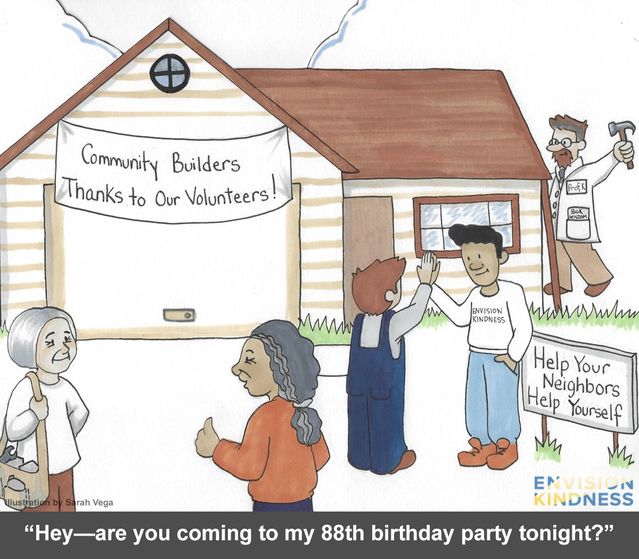
Envision Kindness

Once a month, I volunteer at a meal center to help serve food to people who are in need. Prepping and serving the dinner is a busy yet fun team activity of five to six people, organized by two generous souls. Despite the many other things that I need to do, I really look forward to meeting and serving the patrons, even if only briefly.

Although my motivation begins with wanting to help others and being grateful for what I have been given, it is joy that helps bring me back when I am very busy. I first noticed this some time ago: At the end of our shift, after the kitchen and dining room have been cleaned up, I would experience a lightness of being, a sense of satisfaction and reconnection to purpose. It just feels good.

Allen Luks coined this feeling “the helper’s high,” the sense of euphoria that can be experienced soon after helping someone else. Luks defined two phases—the first characterized by that uplifted, euphoric mood; the second by a longer lasting sense of calm. The greatest effect (the high) was observed in helping strangers.1

A few years ago, as I was researching how kindness affected health, I came to learn that volunteerism was associated with a markedly lower risk of dying. Depending on the study, the decrease in death rates ranged from 20 to 60 percent. For perspective, this is huge. A good example is the introduction of clean drinking water. After water filtration and chlorination were introduced early in the 20th century, death rates from contaminated water dropped about 15 to 20 percent.2

The observations on volunteering come from epidemiologic studies in which populations are followed over time.3 They are complex in that people are living their lives and there are a lot of what are called “confounding variables”—different things happening at the same time. For example, people are getting married or divorced, getting or losing jobs, maybe quitting smoking, or maybe eating and exercising better. In studies like this, it can be hard to sort out cause and effect. That is, maybe people who volunteer live longer simply because they are healthier and able to volunteer.  And perhaps they also have financial resources (don’t have to work two jobs) that frees them to volunteer.

Scientists can try to adjust for these different life events—and with reasonable consistency, studies generally report that the effects of volunteering remain after these adjustments. Following them over time also supports the idea that volunteerism reduces death. One recent and large European study found that self-reported health scores were significantly better in volunteers than in non-volunteers—the difference in scores equivalent to about five years of aging.4

How could volunteering cause a decrease in death? There are several factors at play. The first, and likely most significant, is uplifted mood—that is, lower stress. Multiple studies have provided evidence that volunteering is good for depression, well-being, and social network, among other effects.5It is entirely consistent with Luks’ observations and my own microcosmic experience. Second, people who volunteer regularly also make more effort to take care of themselves, as demonstrated in visits to their doctor for preventive health care.6 Perhaps their networks are chiding them to do so.article continues after advertisement

Finally, people who volunteer may be more physically active, as seen in the Baltimore Experience Corps Trial, a study of the effect of volunteering in older adults. In that study, women (but not men) had a significant increase in walking each day compared to those who did not volunteer.7

To try to tie this together, volunteering likely exerts its positive effects on health by connecting people to others as well as to an activity that they find meaningful. Achieving connection, purpose, and meaning is critical to attenuating stressors of life—particularly loneliness. Since stress is a major cause of disease, especially heart disease, the ability to quench the need for connection, purpose, and meaning can bring about beneficial and salutary changes for people.8 And when there is purpose and we are connected to others, we take care of ourselves.

Most have heard the ancient wisdom that giving benefits the giver more than the receiver. “A generous man will prosper, he who refreshes others will himself be refreshed” from Proverbs speaks to this point. If we look at that solely from a materialistic perspective, the concept is hard to fathom. But if we look at it from a spiritual and now biologic perspective, it totally makes sense.  Even many years ago, our predecessors understood this point without modern scientific techniques.

About 25 percent of the US population volunteers.9 What do you think would happen if we could increase that percentage?

If you can’t volunteer right now but want to get that good feeling, try looking at images of its kindness, compassion, and love. Or go out and photograph it.10  We know that even seeing kindness will give you that feeling.

Sleep – why it’s important and how to get more of it

Mind your Zs: teachers are adding sleep to their lesson plans

Johanne Boursier, a French and ethics teacher at Montreal’s Heritage Regional High School, says she has added sleep to her lesson plans – why it’s important and how to get more of it – because a lack of sleep is hurting her students.

Even the most motivated among them are drowsing off in class, and she says they have trouble focusing and remembering material. Mental-health problems, such as anxiety, have become alarmingly common.

Ms. Boursier is part of a project, spearheaded by McGill University pediatric sleep expert Reut Gruber, which incorporates lessons on the benefits of proper sleep, sleep hygiene and the consequences of poor sleep into everyday class material, from language classes to math and science.

Globe and Mail: http://secure.campaigner.com/csb/Public/show/e7a4-1b5yva–mb9ek-7qf37d18

Almage: About us

About Almage

The centre promotes a “senior helping senior” approach to service delivery.

The goal of Almage is to improve the quality of life of seniors who live independently.

The programs and services are designed to enhance their dignity, support their independence and encourage their community involvement.

If you would like additional information, please contact Almage:

Contact Details

Almage
8680 Hochelaga,
Montreal (Quebec) H1L 2M6

514-355-1712

514-355-0806

Email: info@almage.org

Hours are from 8:30am to 4:30pm, Monday to Friday

Sex in the Senior Years

New research shows the continued importance of sexual intimacy in old age.

Posted Aug 26, 2019

https://www.psychologytoday.com/ca/blog/talking-apes/201908/sex-in-the-senior-years

What do you imagine your sex life will be like in your golden years of retirement? A popular theory of love and marriage proposes that the passionate love of our early years will gradually transform into a companionate love in which nonsexual intimacy prevails over sexual passion. As our bodies grow old and feeble, we may no longer be sexually aroused by our partner—or even be sexually arousable at all. But by this time, our life partner has become our closest friend, the one who knows us better than anyone else.

While such a scenario may have been true in the past, we also need to keep in mind a number of game-changing events that have occurred over the last few decades. In particular, people are living a lot longer than they used to. At least for well educated, financially secure individuals, it’s not at all unreasonable to expect to live into your 80s or 90s with reasonably good health. With about a 20-year increase in life expectancy over the last century, it’s no exaggeration to say that 60 is the new 40, and 80 is the new 60.

To gain a better understanding of the factors influencing sex after sixty, German psychologist Karolina Kolodziejczak of Humboldt University in Berlin and her colleagues surveyed more than 1,500 people 60 years of age or older (ranging from 60-82). The researchers then compared the senior citizens’ responses with a reference group of nearly 500 young adults (aged 22-36). The results of this study show that sexual intimacy is a far more important component of a happy lifestyle in older adults than previously believed.

The participants responded to questionnaires on the following topics:

  • Sexual behavior. Respondents indicated the frequency of sex over the last year, ranging from 0 meaning “never” to 4 meaning “at least once per week.” Importantly, the researchers expanded the definition of sexual activity beyond intercourse to include non-penetrative acts, caresses, and bodily contact. While penetrative intercourse remains the “gold standard” among couples, sex researchers have come to understand that many older couples overcome physical limitations such as erectile dysfunction and vaginal dryness by engaging in non-penetrative acts that still lead to orgasm and feelings of sexual intimacy.
  • Sexual cognitionRespondents used the same 0-4 scale to indicate the frequency of sexual thoughts. Not surprisingly, these were more common than sexual acts, but not by much. Most sexual cognition eventually lead to sexual activity.
  • Sexual affect. The participants responded to several questions regarding the extent to which they experienced intimacy through bodily contact with their partner as well as through conversational exchanges. The average response of these senior citizens was well above the midpoint on the scale, indicating at least general satisfaction in intimacy within this sample.
  • Physical health. All participants underwent a physical exam in which they reported their medical history, and they were tested for physical strength using a grip test. The seniors in this sample were on average in better health than would be expected for this age group.
  • Psychosocial variables. In particular, the researchers considered three variables: relationship status (partnered or single), relationship duration, and relationship satisfaction. Two-thirds of the seniors in this study were partnered, most were in long- term relationships of many years, and relationship satisfaction was generally high. Among both partnered and non-partnered respondents alike, reports of loneliness were quite low.

When the senior citizens were compared against a reference group of younger adults aged 22-36, the results showed a mix of surprising and not-so-surprising results. As expected, the older adults reported fewer sexual acts and thoughts compared with the younger reference group. In contrast, older adults indicated that they experienced similar levels of intimacy as the younger generation. This finding lends support to the idea that marriage transforms over time from a passionate to a companionate relationship.

A closer look at the data, however, reveals some interesting facets of sexuality in the silver years. Most importantly, there was a high degree of variability in the frequency of sexual activity among senior citizens. While many were having sex far less frequently than the 20- and 30-year-olds, a full third of them reported that they were having sex more often than the average for the younger generation. In other words, a significant portion of older adults had a sex life that would make most young adults envious!

The vigorous sex life of senior citizens is no doubt due to the vastly improved health of people in this age range. In fact, statistical analyses indicated that health was not an important predictor of sexual frequency in older adults, as is generally assumed. Rather, the most important factor was having a partner. In other words, those senior citizens in committed relationships were having sex quite often, while those who were widowed or divorced often led a sexless existence. It’s also important to point out that whereas many of these relationships were decades-long marriages, they also included newer partnerships formed after widowhood or divorce.

By the way, it’s important to emphasize that this sample was better educated and enjoyed better health than the general population. So it may still very well be the case that poor health is an impediment to sexual activity in later life, as is generally believed. But among those senior citizens who still enjoy good health, the key to a happy sex life is the availability of a partner within a committed relationship.

In conclusion, the study provides encouragement for all of us as we advance in our years. People are living longer—and staying healthy longer—than ever before. Those of us who remain in good health into our silver years can look forward to a meaningful sex life well into old age. And given the physical and psychological health benefits of an active sex life, one has to wonder whether having lots of sex in old age is one factor that keeps these senior citizens so healthy.

References

Kolodziejczak, K. et al. (2019). Sexual activity, sexual thoughts, and intimacy among older adults: Links with physical health and psychosocial resources for successful aging. Psychology and Aging, 34, 389-404.